F3 Talks 01 - Why Startups Fail

Share article
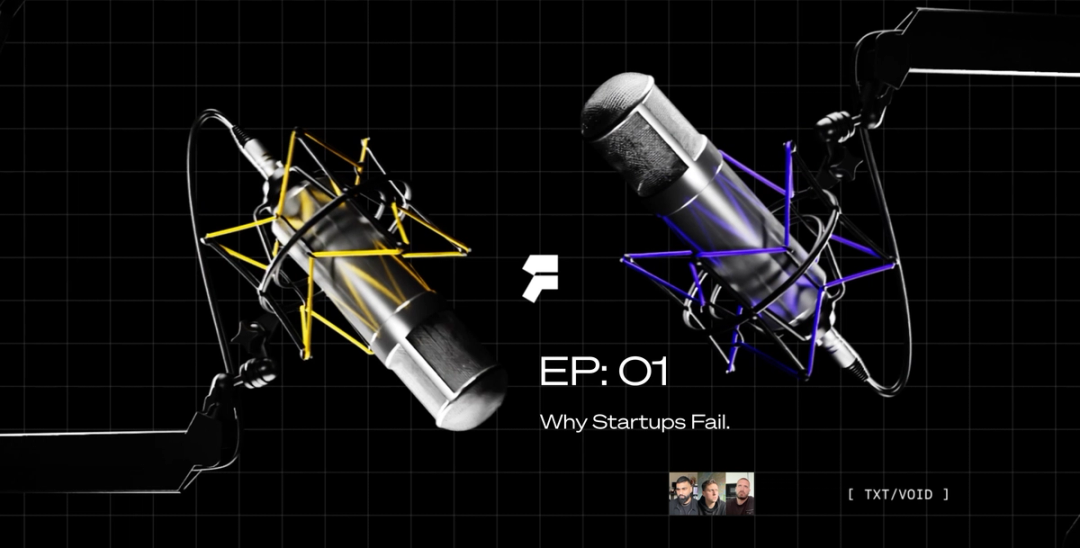
Hardy Sidhu (Founder, Format-3), Kev (CSO, Format-3), and Roman (COO, Format-3) sit down to unpack a simple, uncomfortable question: why do so many startups fail?
The tools for building have improved beyond recognition. AI can turn an idea into a working product in days. Barriers to entry have collapsed. Capital is still available. Yet the familiar statistic remains stubbornly intact: around 90 percent of startups do not make it long term.
That paradox sits at the heart of the discussion.
One part of the problem is language. “Startup” has drifted from meaning a company built for rapid scale to simply meaning a company that is new. That shift feels subtle, but it is not. Being new is easy. Being scalable is rare. Many founders label themselves a startup long before they have built anything that could credibly grow like one.
Another deeper issue is the myth that continues to haunt product culture: build it and they will come. Teams spend months perfecting features, interfaces, and architecture while treating distribution as an afterthought. Growth becomes a line in a strategy deck rather than a system that is tested in the real world.
As Kev puts it:
“You can build a product, launch a product — it doesn’t mean anyone will know it exists.”
The conversation also challenges how founders understand MVP. The dominant interpretation, “a basic version of the product you can launch”, is expensive and often misguided. A true MVP is not about shipping a product. It is about discovering whether you are even building the right thing. That might be a waitlist, a prototype, a demo video, or even a manual service dressed up to look like software. The objective is learning, not launch.
AI complicates this further. It accelerates building to the point where many founders move faster than they can think. Speed begins to masquerade as progress, and strategy gets squeezed out by output.
But perhaps the most important theme that emerges is not about technology at all. It is about trust.
In a world where anyone can build a functional AI tool, capability is no longer the primary differentiator. The winners will be the products that feel legible, reliable, and human. The experiences that show their work, explain themselves, and respect the psychology of their users. Sometimes that even means slowing down rather than rushing.
There is also a philosophical divide that quietly shapes success and failure. Scientists run experiments to prove themselves wrong. Businesses often run experiments to prove themselves right. That difference determines how much runway gets burned, how quickly teams pivot, and how emotionally attached founders become to their own ideas.
When the group turns to examples of companies that did succeed — Uber, Airbnb, Pinterest — the common thread is not superior technology. It is behaviour change. These companies turned services into habits. They built defaults, not just features. They scaled usage before profit and created real societal need rather than assuming it existed.
From this, a clearer picture of what works begins to form.
Validate desirability fast, in weeks rather than quarters. Treat customer acquisition as part of the product, not a marketing exercise that happens later. Stay loyal to the problem you are trying to solve, not the first solution you fall in love with.
As Hardy says toward the end of the conversation:
“Design experiences people want to use, not have to use.”
Most importantly, surround yourself with people who will challenge you early, not agree with you quickly.
Startups are not failing because the tools are weak. They are failing because thinking is. In a world where anyone can build, advantage belongs to those who can learn faster than they ship, and design not just for function, but for trust.
The future will not reward the fastest coder. It will reward the clearest thinker.

More thoughts
Thought leadership creates value, builds knowledge and takes a stand, bridging the gap between traditional and digital platforms

Agent-first brands: Adapting for AI-driven discovery
Discover how agent-first brand strategy is reshaping discovery in technology, healthcare, and entertainment as AI agents become the gatekeepers of purchase decisions.

Driving Growth with Attention, Transparency, and Friction
Discover how our approach helps the team thrive and deliver impactful work.
SayHello!
- 18:34:23NashvilleUSA
- 19:34:23New YorkUSA
- 24:34:23LondonUK
- 01:34:23KatowicePoland
- 01:34:23BratislavaSlovakia
- 02:34:23PlovdivBulgaria
- 03:34:23DubaiUAE